Note: the actions, contraindications and usage sections are currently published in Arabic (primary market content); translations are in progress. Herb name, nature, taste and meridians are shown as is.
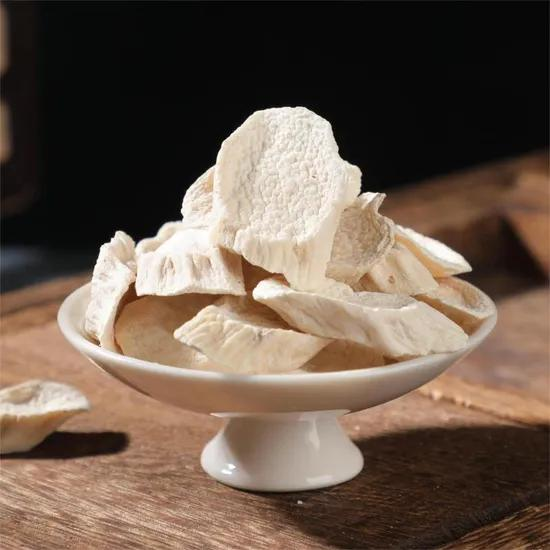
Shan Yao
山药 Shan Yao
Dioscoreae Rhizoma
💊 Actions
Nourishes the Spleen, Lung, and Kidney together; for weak children, the elderly, and chronic diarrhea.
Contraindications
Very safe; large amounts are contraindicated for those with severe abdominal distension.
📖 Usage & Dosage
15-30 grams, cooked as soup or porridge.
📖 In-Depth Guide
What Is Shan Yao (Chinese Yam)?
Shan Yao, listed as Dioscoreae Rhizoma, is the thick, starchy rhizome of the Chinese yam, a climbing vine grown widely across East Asia for both the table and the pharmacy. After winter harvest the tubers are peeled, trimmed, sulphured or smoked according to traditional processing, and dried into firm white slices or cylinders that soften when cooked and taste sweet and mild. In English it is called Chinese yam or dioscorea, and it is one of the best-known dual-use food and medicine herbs, sold dried as white slices and also eaten fresh in soups and porridges. It is not the sweet potato, despite some regional nicknames.
TCM Properties and Actions
Chinese yam is neutral in nature, sweet in flavor, and enters the Spleen, Lung, and Kidney meridians. What makes it unusual is its balanced coverage of all three of these organs. The record states that it nourishes the Spleen, Lung, and Kidney together and suggests it for weak children, the elderly, and chronic diarrhea. In TCM terms it supplements Spleen qi to support digestion and bind loose stools, gently tonifies Lung qi and yin for a weak voice, shortness of breath, and a dry, chronic cough with little sputum, and stabilizes Kidney essence for the urinary, lower-back, and reproductive weakness seen in older or depleted people. Because it is neutral and gentle rather than forceful, it is considered suitable for slow nourishment of frail constitutions.
Traditional Use and Common Combinations
The traditional picture for Shan Yao is mild, long-term deficiency rather than acute illness: poor appetite with persistent loose stools, a tired child or older person who catches chills easily, a dry lingering cough, and weak lower back or urinary frequency in the elderly. It appears alongside prepared rehmannia and cornus fruit in the six-ingredient rehmannia formula family to support the Spleen and Kidney, and it is cooked alone or with rice as congee for everyday digestive support. The record specifically associates it with weak children, the elderly, and chronic diarrhea. Chronic diarrhea in real practice, however, warrants medical evaluation for infection, food intolerance, inflammatory bowel disease, and other modern conditions, especially with weight loss or blood.
Safety, Contraindications, and Interactions
The recorded safety profile is favorable: Shan Yao is described as very safe. The one restriction is that large amounts are contraindicated for those with severe abdominal distension; because it is starchy and binding, a heavy intake can worsen marked bloating, fullness, and constipation, and it is also unsuitable as a tonic during an acute illness with a thick tongue coat. Fresh yam mucilage can irritate the skin when peeling, causing itching in sensitive people, and a true food allergy is possible. Even though it is a food, pregnant or breastfeeding women, infants, and people with serious illness should treat medicinal quantities as a matter for a qualified practitioner rather than a free-for-all.
How TCM Practitioners Use It Today
The recorded use is 15-30 grams, cooked as soup or porridge. The dried white slices are simmered in soups and congee until soft, often in food-style quantities, and practitioners may prefer the stir-fried form for stronger spleen support and the unprocessed form for lung and kidney yin nourishment. Because quality varies, choose clean, dry, well-stored slices. This guide is educational and does not replace professional medical advice, diagnosis, or treatment.
Frequently asked questions
Is Shan Yao safe during pregnancy?
As a common food it is generally well tolerated, but regular medicinal amounts during pregnancy and breastfeeding should still be discussed with a qualified practitioner, especially if there is marked bloating or constipation, and it should not be used to self-treat persistent diarrhea.
Can Shan Yao replace prescription medication?
No. It is a gentle traditional food herb that supports the Spleen, Lung, and Kidney in patterns of weakness and chronic loose stools; it cannot replace prescribed treatment, and ongoing diarrhea, weight loss, or blood in the stool requires medical investigation.
What is the difference between raw and stir-fried Shan Yao?
Both forms are the same dried yam. The unprocessed white slices are neutral and slightly cooling and are traditionally used to nourish Lung and Kidney yin for dry cough and lower-body weakness. The stir-fried slices are warmer and slightly more aromatic, and are preferred for strengthening the Spleen to address poor appetite and chronic loose stools.
🏠 Chinese yam
A popular food-medicine dual-use herb; sold dried as white slices.
💊 Formulas with this herb
🧭 Explore more
🌿 Related Herbs
Related conditions
Medical disclaimer: this content is for health education only and does not constitute diagnosis or treatment advice. Consult a qualified healthcare practitioner before use; some herbs may interact with medications and require special caution during pregnancy or breastfeeding.