Benefits of Cupping for Men Who Smoke
Many smokers seek cupping because they believe it helps reduce the effects of smoking on the body. Traditionally, cupping has been used to stimulate blood circulation and relieve chest congestion and accumulated phlegm. But it is important to be honest: cupping is not a treatment for smoking, and quitting smoking remains the first and most important step for your health.
Why Are Smokers Interested in Cupping?
Smokers make up a large proportion of men over thirty in the Arab world. As awareness of the dangers of smoking grows, many look for ways to "cleanse the body" or "reduce harm." With its heritage in Prophetic medicine and traditional Chinese medicine, cupping appears as a natural option — but its limits must be understood honestly.
What cupping cannot do:
- It will not "clean" the tar out of your lungs
- It will not cancel the smoking-related risks of cancer or heart disease
- It is not a substitute for quitting
What it may traditionally help with:
- Stimulating blood circulation in the chest and back area
- Easing the feeling of breathlessness associated with congestion
- Reducing stress and anxiety (both of which drive smoking)
- Supporting the body during the quitting period
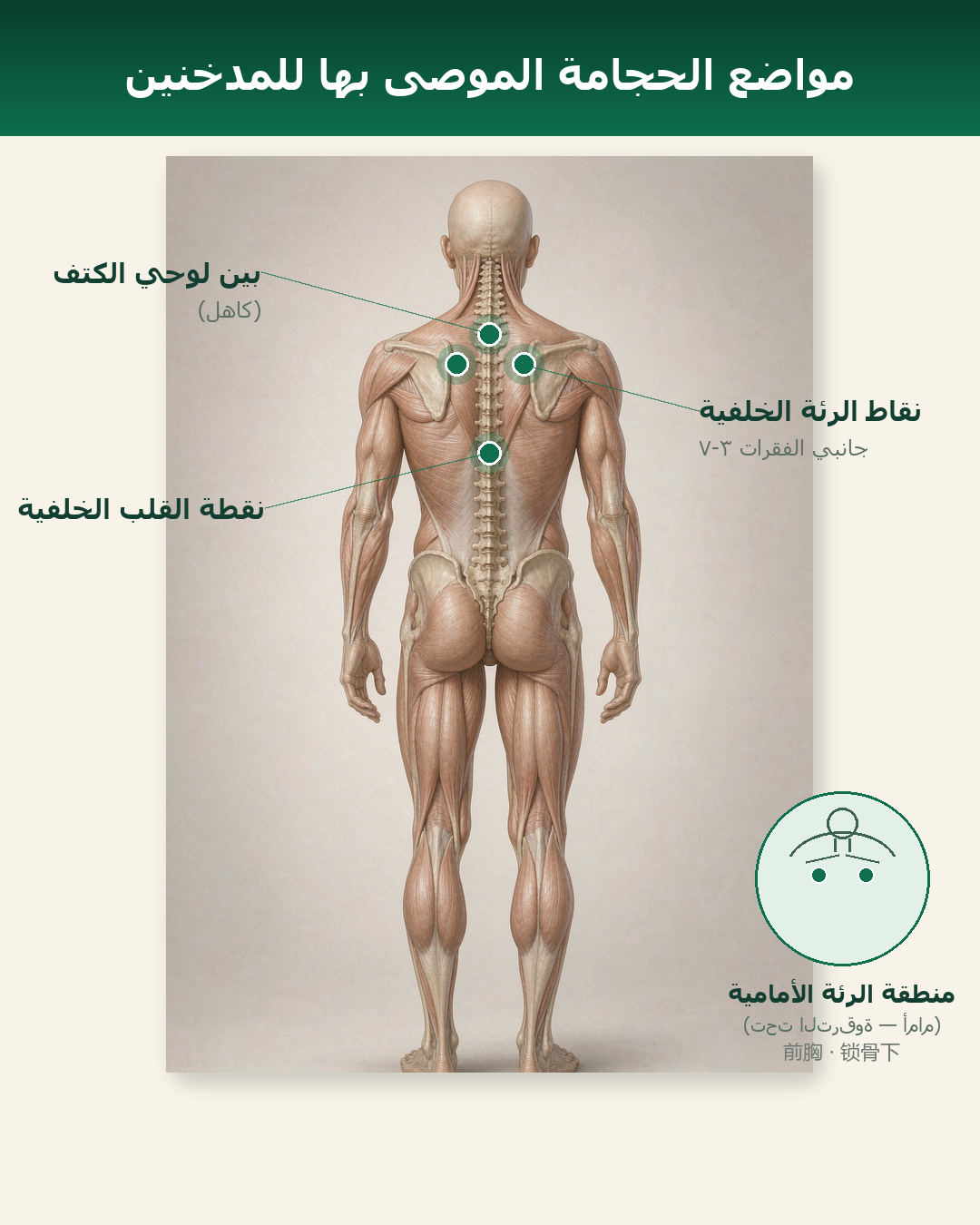
Recommended Cupping Points for Smokers
| Location | Arabic name | Traditional benefit |
|---|---|---|
| Upper back, between the shoulder blades | al-Kahil (upper back) | Traditionally used to relieve chest congestion |
| On both sides of the spine at thoracic vertebrae 3–7 | Back-shu points of the lung (背俞穴, beishu points) | In Chinese medicine, attributed to stimulating lung function |
| Upper chest, below the collarbone | Front lung area | Traditionally used to move phlegm |
| Mid-back | Back point of the heart | Traditionally used to support blood circulation |
Important note: These locations come from the traditional medical heritage (Prophetic and Chinese). Cupping must be performed by a qualified practitioner who knows anatomy and uses sterilized equipment.
A Cupping Plan to Accompany Smoking Cessation
If you are on a journey to quit smoking, some traditional practitioners suggest this framework:
Weeks 1–2: two sessions to stimulate circulation and ease early withdrawal symptoms (tension, headache, chest tightness)
Weeks 3–4: one session to maintain momentum, focusing on relaxation points
After the first month: an optional monthly maintenance session
⚠️ This is a general framework. Your health condition may require adjustments. Consult a qualified cupping practitioner.
Special Precautions for Smokers
- Smokers are more prone to bruising due to fragile blood vessels
- Do not undergo cupping if you have an acute cough or acute pneumonia
- If you take blood-thinning medication, consult your doctor first
Signs at which you should stop:
- Bleeding that does not stop after cupping
- Severe dizziness or nausea
- Signs of infection at the cupping site (redness, swelling, heat)
Frequently Asked Questions
Does cupping help with quitting smoking?
There is no conclusive scientific evidence that cupping helps people quit directly. However, it may ease some withdrawal symptoms such as tension, headache and breathlessness, which can make it easier to stick with the decision to quit.
How many cupping sessions does a smoker need?
There is no standard number. It depends on your age, health condition, how long you have smoked, and your goals (prevention or cessation support). A qualified practitioner is the one who determines the appropriate number.
Can I have cupping while I still smoke?
Yes, but it is advised not to smoke for at least two hours before and 4 hours after cupping. Nicotine constricts blood vessels, which may reduce cupping's effectiveness.
Does cupping remove toxins from the body?
The idea of "detoxing" through cupping is popular but not scientifically proven. The liver and kidneys are what remove toxins. Cupping traditionally stimulates local blood circulation, which is different from "cleansing the body."
Sources
- 1Ibn al-Qayyim al-Jawziyya, Prophetic Medicine (al-Tibb al-Nabawi) — chapter on cupping and its benefits
- 2Ibn Taymiyya, Heart Remedies (al-Adwiya al-Qalbiyya) — on cupping's effect on the heart
- 3Al-Shafi'i, Kitab al-Umm (The Mother Book) — rulings on cupping
- 4Huangdi Neijing (Yellow Emperor's Inner Canon, the source of Chinese medicine) — chapter on cupping therapy
- 5Ahmad ibn Abi Du'ad, The Book of Cupping (Kitab al-Hijama)
⚠️ Medical disclaimer: This article is for educational purposes only and does not replace consultation with a doctor. Cupping does not treat smoking or its damage. Quitting smoking is the most important step for your health. If you are thinking of quitting, ask your doctor about the programs available.